
Northwest Iceland
Northwest Iceland (Norðurland vestra) covers the Húnavatn districts and Skagafjörður. The region is one of the country's main farming areas and the cradle of Icelandic horse culture. It also has important historic sites, including Hólar in Hjaltadalur, the bishop's seat and centre of learning in the north for nearly seven centuries.
Skagafjörður
Skagafjörður is a broad, fertile fjord with many farms and historic sites. It is often called the cradle of the Icelandic horse, as there are more horses here than almost anywhere else, and the national horse show (Landsmót) has often been held at Vindheimamelar. Sauðárkrókur, the largest town in the region, has a strong fishing industry, a tannery and a comprehensive college.
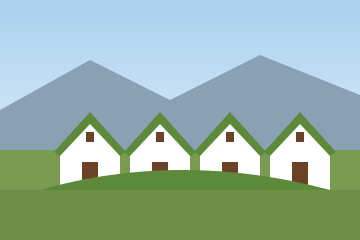
Glaumbær in Skagafjörður is one of the best-preserved turf farms in Iceland and houses the Skagafjörður Heritage Museum. In Hofsós the Icelandic Emigration Center tells the story of the Icelanders who emigrated to North America between 1870 and 1914. The village also has an innovative swimming pool overlooking the fjord towards Drangey. Varmahlíð has a service centre and popular river-rafting companies on the Jökulsá rivers of Skagafjörður.
Hólar in Hjaltadalur
Hólar was the bishop's seat of North Iceland from 1106 to 1801. Jón Ögmundsson was the first bishop, and the last Catholic bishop, Jón Arason, was beheaded at Skálholt with his sons in 1550. Jón Arason brought the first printing press to Iceland around 1530. Bishop Guðbrandur Þorláksson had the first complete Icelandic translation of the Bible printed at Hólar in 1584, the so-called Guðbrandsbiblía. Hólar Cathedral, built in 1763, is the oldest stone church in Iceland. Today Hólar is home to a university specialising in tourism, aquaculture and equine studies.
Drangey and Grettir the Strong
Drangey is a cliff island in the middle of Skagafjörður, about 180 metres high. According to Grettir's Saga, the outlaw Grettir Ásmundarson spent his last years there with his brother Illugi. The saga says that Grettir swam from Drangey to the mainland, about seven kilometres, to fetch fire, and then bathed in Grettislaug at Reykir. The swim has been repeated by several swimmers in modern times. In summer there are boat trips to Drangey, which has rich birdlife.
The Húnavatn districts
- Hvítserkur – a 15-metre sea stack off eastern Vatnsnes that looks like a giant beast drinking.
- Vatnsnes – one of the best places in Iceland to see seals.
- Hvammstangi – home of the Icelandic Seal Centre.
- Borgarvirki – a natural basalt fortress thought to have been used for defence in ancient times.
- Þingeyrar – an ancient monastery (1133) where several of the sagas are thought to have been written; the stone church dates from 1877.
- Kolugljúfur – a beautiful canyon with waterfalls in Víðidalur.
- Blönduós – a town at the mouth of the Blanda river, with the Textile Museum.
- Skagaströnd – an old trading post and the home of country music in Iceland.
Economy
Farming is the backbone of the economy, especially sheep, cattle and horse breeding. Fishing is important in Sauðárkrókur and Skagaströnd. Tourism has grown, not least horse riding tours, the autumn horse round-ups and cultural tourism. Salmon fishing in the Húnavatn districts is among the best in Iceland, for example in the Blanda, Vatnsdalsá and Laxá á Ásum rivers.
Frequently asked questions
Where is Hvítserkur?
Hvítserkur is off the eastern side of the Vatnsnes peninsula in Húnaþing vestra, about 30 km from the Ring Road.
When was Hólar a bishop's seat?
Hólar in Hjaltadalur was a bishop's seat from 1106 to 1801.